
AMOS STAR is a U.S. Space Force and Air Force plan for up to seven new telescopes and a satellite surveillance station on the summit. These are the reasons it must be stopped: water, sacred land, a military that has not cleaned up its spills, and a review process that has skipped steps required by federal and Hawaiʻi law.
Explore the AMOS STAR Project
- Timeline — spills, resistance and the military’s ambitions
- Alternative Sites & Systems
- The HEPA Story
- Legal Analysis and Legal Framework
- Public Records Requests
- The Record: Community Voices
- AMOS STAR in the News
- Take Action
The ten issues
1. East Maui watershed protection
The summit sits directly above the East Maui watershed, which supplies about two-thirds of Maui’s drinking water.
- The watershed feeds directly into the island’s aquifers.
- Industrial activity at the summit raises real concerns about runoff and the health of the ecosystem.
- Any expansion at the summit threatens the source of life for Maui’s people.
2. The 2023 diesel spill: a failure of oversight
More than 700 gallons of diesel spilled at the Air Force site in January 2023, and cleanup is still open more than three years later.
- The spill was first blamed on a lightning strike, but investigations did not support that explanation.
- Investigators found that preventive maintenance had failed and proper leak-detection equipment was missing.
- Earlier spills at the same site were never disclosed to the public.
3. Sacred land and cultural identity
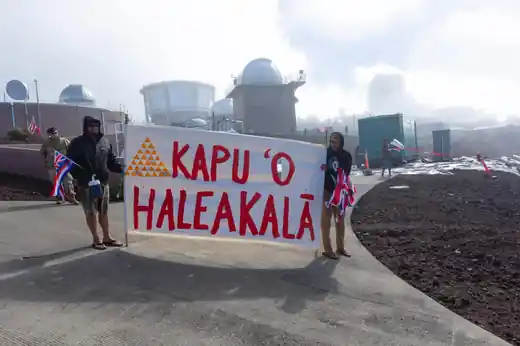
Haleakalā is a sacred relative, not just a place to put telescopes.
- The Air Force itself acknowledges “adverse effects” to the summit as a Traditional Cultural Property.
- Building here desecrates Wao Akua, the realm of the gods.
- Kūpuna and cultural practitioners face restricted access to the summit.
- The summit’s piko connects families to generations of umbilical-cord burial sites.
4. Legal and procedural failures
The federal review did not take the “hard look” at alternatives that the National Environmental Policy Act (NEPA) requires.
- Sites on the continent were dismissed without a rigorous comparison.
- Consultation with Native Hawaiian organizations under Section 106 has been inadequate.
- The project was reshaped in ways that sidestep state review.
- Key Hawaiʻi-law questions are unanswered: the Conservation District, use of State land, Chapter 6E historic review, and a Ka Paʻakai analysis.
5. Alternative sites and systems
Other locations and technologies could match or exceed what AMOS STAR would do, without touching sacred land.
- White Sands, New Mexico already has Department of the Air Force infrastructure.
- Mt. Hopkins and Kitt Peak, Arizona have proven atmospheric quality for observation.
- Space-based systems avoid the atmosphere entirely and offer global coverage.
6. The HEPA story
The Air Force changed the project in ways that avoided review under Hawaiʻi’s Environmental Policy Act (HEPA, HRS Chapter 343).
- HEPA is the community’s main legal protection, and avoiding it undermines that protection.
- The changes appear designed to avoid state permits.
- The result is less oversight of a project that affects sacred land — a defiance of state and county authority.
7. Maui County Council Resolution 24-103
Maui’s leadership is united against the project.
- The Maui County Council voted 9–0 to oppose AMOS STAR (Resolution 24-103).
- The Mayor’s Office is on record in opposition.
- OHA Trustee Hulu Lindsey is on record in opposition.
8. The Section 106 consultation gap
Formal consultation with Native Hawaiian organizations did not begin until January 2026.
- Earlier Air Force communications claimed consulting-party views had already been gathered.
- That led to inaccurate reporting to federal agencies.
- The delay in meaningful consultation violates both the spirit and the letter of Section 106.
9. Space war and surveillance
AMOS STAR is part of the military’s preparation for warfare in space.
- Its focus is “space domain awareness” — tracking and watching objects in orbit for military purposes.
- Testifiers warned that Haleakalā could become a strategic military target, raising the risk to everyone on Maui.
- A surveillance economy is overriding community values.
10. The AMOS and SISL connection
A U.S. Space Force spokesperson called SISL and AMOS STAR “separate and distinct” — but the Air Force’s own draft EIS (page 1-2) says SISL would connect to the summit complex through high-speed fiber-optic links.
- SISL is a 56,000 sq. ft. facility cleared under a separate 2022 Environmental Assessment — splitting one project into two reviews.
- No study gives combined power or water figures for the two facilities.
Has the military followed the law?
What federal and Hawaiʻi law require before anything is built, and where each step stands, as tracked by our partners at Protect Haleakalā.
| Requirement | Law | Status |
|---|---|---|
| Genuine alternatives analysis | NEPA | Not done |
| Proof other sites won’t work | NEPA | Shown by County and community |
| Meaningful historic consultation | Section 106 | Not done |
| Supplemental EIS | NEPA | Not started |
| Cumulative impacts with SISL | NEPA | Not done |
| Answers to public-records requests | UIPA / FOIA | Delayed — 3 of 5 pending |
| Environmental review | HEPA, HRS Ch. 343 | Awaiting |
| Conservation District permit | Hawaiʻi | Awaiting |
| State land consent (EO 4451) | Hawaiʻi | Awaiting |
| Historic preservation review | HRS Ch. 6E | Awaiting |
| Ka Paʻakai analysis | Hawaiʻi Constitution | Not done |
| County review of SISL | Maui County | Bypassed |
AMOS STAR timeline
- May 13–15, 2023: Scoping meetings in Kahului, Pukalani and Kīhei draw near-unanimous opposition.
- 2024: Maui County Council passes Resolution 24-103, 9–0. Mayor Bissen writes the Air Force in opposition.
- January 2026: Draft EIS released. Formal Native Hawaiian consultation begins.
- February 17–18, 2026: Public hearings in Kīhei and Pukalani.
- March 9 – April 15, 2026: Comment period extended 30 days after community requests; more than 650 written comments submitted.
- March 11, 2026: Hanohano ʻO Haleakalā community event at UH Maui College.
- September 2026: Public-records (UIPA) requests filed; peaceful protest at the AMOS Conference in Wailea; draft Memorandum of Agreement discovered.
- November 16, 2026: A morning of ceremony at the piko of Haleakalā.
Four spills on the summit
- 1980s: diesel contamination at the AMOS Butler Building, not disclosed until 2026
- About 2010: chiller coolant spill at the surveillance site, never disclosed
- About 2015: generator coolant spill requiring soil removal, no public notice
- January 2023: more than 700 gallons of diesel; cleanup still not finished
Go deeper at ProtectHaleakala.com.
Issue summaries are based on the work of our partners at the Protect Haleakalā Coalition. Read their full analysis at ProtectHaleakala.com/issues.