
Four decades on the summit: the spills, the resistance, and the military’s growing ambitions for Haleakalā.
The spills
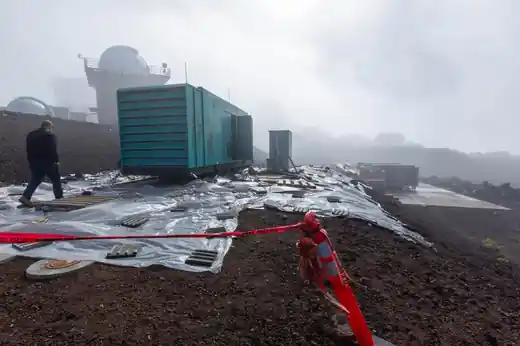
- 1980s: First documented diesel contamination at the AMOS Butler Building — not publicly disclosed until 2026.
- About 2010: Chiller coolant spill at the Maui Space Surveillance Site, with no public disclosure.
- About 2015: Generator coolant spill requiring soil removal, with no public notice.
- January 2023: More than 700 gallons of diesel spill at the AMOS site, first blamed on lightning. Cleanup is still open.
The resistance
- 2005: Kilakila ʻO Haleakalā’s opposition to the solar telescope begins at the first public scoping meeting.
- 2010: Kilakila challenges the BLNR decision allowing DKIST construction.
- 2013: The Hawaiʻi Supreme Court rules BLNR should have held a contested case hearing.
- October 6, 2016: The Hawaiʻi Supreme Court upholds the DKIST permit and the summit management plan review, ending Kilakila’s lawsuits.
- 2015 and 2017: Dozens of protectors are arrested at the summit during demonstrations against DKIST equipment transport.
- 2019: Kūpuna are arrested on Mauna Kea during the TMT standoff.
- May 13–15, 2023: AMOS STAR scoping meetings in Kahului, Pukalani and Kīhei draw near-unanimous opposition.
- June 2024: Maui County Council passes Resolution 24-103, 9–0. Mayor Bissen writes the Air Force in opposition.
- Late January 2026: The Air Force admits formal Native Hawaiian consultation only began in 2026.
- February 17, 2026: First AMOS STAR EIS public hearing, in Kīhei.
- February 18, 2026: Second hearing, in Pukalani, draws an even larger crowd.
- February 20, 2026: Information request sent to the State Historic Preservation Division.
- March 9, 2026: After community requests, the Air Force extends the draft EIS comment period by 30 days, through April 15.
- March 11, 2026: Hanohano ʻO Haleakalā community evening at UH Maui College, with the Air Force invited.
- September 7, 2026: First official public-records (UIPA) request for AMOS STAR records.
- September 15, 2026: Peaceful stand at the Wailea Beach Resort entrance during the AMOS Conference.
- September 25, 2026: A draft Memorandum of Agreement is found, citing a list of invited Native Hawaiian Organizations that is not included.
- September 29, 2026: Second records request to BLNR on the Ka Paʻakai analysis, land title and HEPA.
- October 22, 2026: UH Board of Regents approves the Maui High Performance Computing Center lease 11–0; Maui’s questions go unanswered.
- November 16, 2026: A morning of ceremony at the piko of Haleakalā.
The ambition: the AMOS Conference
Each September the military and defense industry gather in Wailea for the AMOS Conference (Advanced Maui Optical and Space Surveillance Technologies). The number of research papers presented tracks the growth of military interest in Haleakalā. Click a year to see that year’s conference archive.
Papers presented at the AMOS Conference
- 2006: 102 papers
- 2013: 99 papers
- 2017: 128 papers
- 2019: 90 papers
- 2019–2022: output nearly doubles to 193 papers, as AMOS STAR is planned internally (see 2020, 2021, 2022)
- 2023: a peak of 209 papers — the same year as the 700-gallon diesel spill
- 2025: 164 papers
Paper counts as reported by the Protect Haleakalā Coalition. Read the papers yourself on the AMOS technical papers page, or browse all AMOS Conference archives.
Military planning documents
- January 2026: AMOS STAR draft environmental impact statement released
- April 15, 2026: U.S. Space Command releases Objective Force 2040
- July 27, 2026: Space Warfighting Environment 2040 released, identifying fixed military sites as targets
Based on the work of our partners at the Protect Haleakalā Coalition. See the original at ProtectHaleakala.com.